Prime
Racism alive and well in South Africans
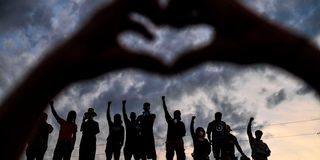
Despite the uproar and public lambasting that takes place in each case where an instance of racism goes viral, with some severe punishment for offenders, racist tropes are still routinely flung about by some S Africans.

What you need to know:
- Fiery political leader Julius Malema is another figure who has also been accused of racist, violence-inciting hate speech for comments about “cutting the throat of whiteness”, among others.
- Vicki Momberg, 48, was found guilty of crimen injuria in 2018 and sentenced to three years behind bars, one suspended, after repeatedly using vile language and the “k-word” to, and about, traffic officers.
South Africans have experienced yet another high-emotion incident of ugly racism, showing that 30 years after the dismantling of 350 years of colonial and apartheid-enforced ‘white supremacy’, racist mind-states persist.
This past week, S Africans have been trying to make sense of an argument that began on social media to do with pitbull terriers – often used in illegal dog-fighting as they can be bred and trained to be vicious, but are not automatically so.
This followed the deaths of a child and a woman in separate mauling incidents involving this controversial breed, which suddenly took a turn into racist slurs, anti-white sentiments and death threats.


A voice note ‘contribution’ to the ‘pitbull debate’ was so obnoxious and outrageous that not only have serious criminal charges been laid against the commentator, named as Belinda Magor, but the Azanian People's Organisation (AZAPO) wants her thrown out of South Africa.
In the voice note, which immediately went viral, Magor can be heard saying that black men are “worse than pitbulls”, that black men should be “banned, shot and killed” and that black women should have their uteruses removed.
Magor was subsequently arrested and has been charged with crimen injuria, with AZAPO laying complaints of hate speech, incitement to violence and incitement to commit genocide.
The South African Human Rights Commission labelled the clip “disturbing and deplorable” and is also probing the incident, with civil society grouping Right2Know saying Magor “deserves to be jailed”, but also that “such utterances beg the question of whether the Truth and Reconciliation Commission (TRC) was effective or not”.
The TRC, held under the auspices of Archbishop Desmond Tutu, took place in the late 1990s in a bid to get at the truth of what happened under apartheid to opponents of the race-based system of oppression and help heal the wounds of 350 years of racist domination of black-skinned and ‘non-white’ groupings, collectively comprising over 80 percent of S Africa’s population.
By telling the full truth of apartheid’s abuses, some of the system’s evils would be exposed, thereby offering closure to its victims – and perhaps also setting the scene for a future free of systemic, or any, form of racism.
This was the hope behind the establishment of the TRC, which, it was also hoped, could be the template for a ‘fresh start’ between SA’s races, tribes and groupings, some of whom had been set against each other using the classic ‘divide and rule’ colonialist tactic.
The questioning of the efficacy of the TRC process in markedly resolving race relations has been given increasing credence in that the Magor incident is one of a growing list of similar instances of S Africans being overtly racist – and it is not always the ‘white’ grouping that is at fault.
Last year’s rioting that followed the jailing of former president Jacob Zuma, in which billions were lost in looting and arson attacks and over 300 died, also saw at least 30 black S Africans allegedly shot down by ‘vigilante’ groupings ‘protecting’ properties and homes near one of Durban’s largest informal settlements.
While the administration of President Cyril Ramaphosa thanked citizens who took to the streets to provide protection to neighbourhoods, shops and facilities during the riots – and which the authorities were otherwise too busy to protect while dealing with numerous mass looting events – the ‘vigilante’ shootings on the outskirts of a middle-income Durban suburb largely populated by people of Indian extraction is still under formal investigation.
Allegations of racism have been levelled against those who stopped marauding mobs of looters from entering areas where their homes and businesses were located.
Fiery political leader Julius Malema is another figure who has also been accused of racist, violence-inciting hate speech for comments about “cutting the throat of whiteness”, among others.
But it is frequently white people who inexplicably believe it is acceptable to make, publicly and overtly, racist and repugnant comments, which are also illegal in S Africa, despite a constitutional right to ‘free speech’.
There have been a number of notable cases, including the University of Stellenbosch student (‘white’) who drunkenly, but openly and while being filmed on a cellphone, urinated on the laptop computer and desk of a fellow (black) student.
Two weeks ago, student Theuns du Toit lost his appeal against his expulsion from the university as part punishment for his “grossly racist and vile conduct”.
In May, Du Toit was filmed urinating on the property of fellow student Babalo Ndwayana and was expelled.
That incident also caused an uproar with, again, questions circulating widely about the true state of race relations in the ‘rainbow nation’.
In August 2018, holidaying S African Adam Catzavelos tweeted from a beach in Greece about the entire absence of black people on that beach, using a vile colonial- and apartheid-era derisive term for black people.
In February 2020, Catzavelos pleaded guilty to and was found guilty of crimen injuria and sentenced to a fine of about $3,000, or two years' imprisonment, both wholly suspended for five years, for using the “k-word”.
In his damning self-recorded video, he said he was revelling in the fact there were no black people on the beach: “Not one k***r in sight, f*king heaven on earth... You cannot beat this!”
Another similarly foul-mouthed offender, Vicki Momberg, 48, was found guilty of crimen injuria in 2018 and sentenced to three years behind bars, one suspended, after repeatedly using vile language and the “k-word” to, and about, traffic officers.
The unrepentant Momberg has subsequently said she felt “victimised” and has attempted to sue the police minister for wrongful arrest.
These incidents – among others that come to the fore with regularity and have living echoes of attitudes supposedly part of this country’s past – have illustrated how deeply entrenched racial, ethnic and even tribal conditioning can be.
These patterns of “othering” are still to be found in people of any colour or grouping, say sociologists here, who have been studying the stubborn nature of attitudes no longer considered socially acceptable, and made overtly illegal as hate speech punishable by imprisonment.
Despite the uproar and public lambasting that takes place in each case where an instance of racism goes viral, with some severe punishment for offenders, racist tropes are still routinely flung about by some S Africans.
These are the people who have been inured to generations of stereotyping of other races, ethnic cultural and linguistic groupings, even including deep-seated tribalism between people with only minor variations of origin, such as between Xhosas and Zulus.


